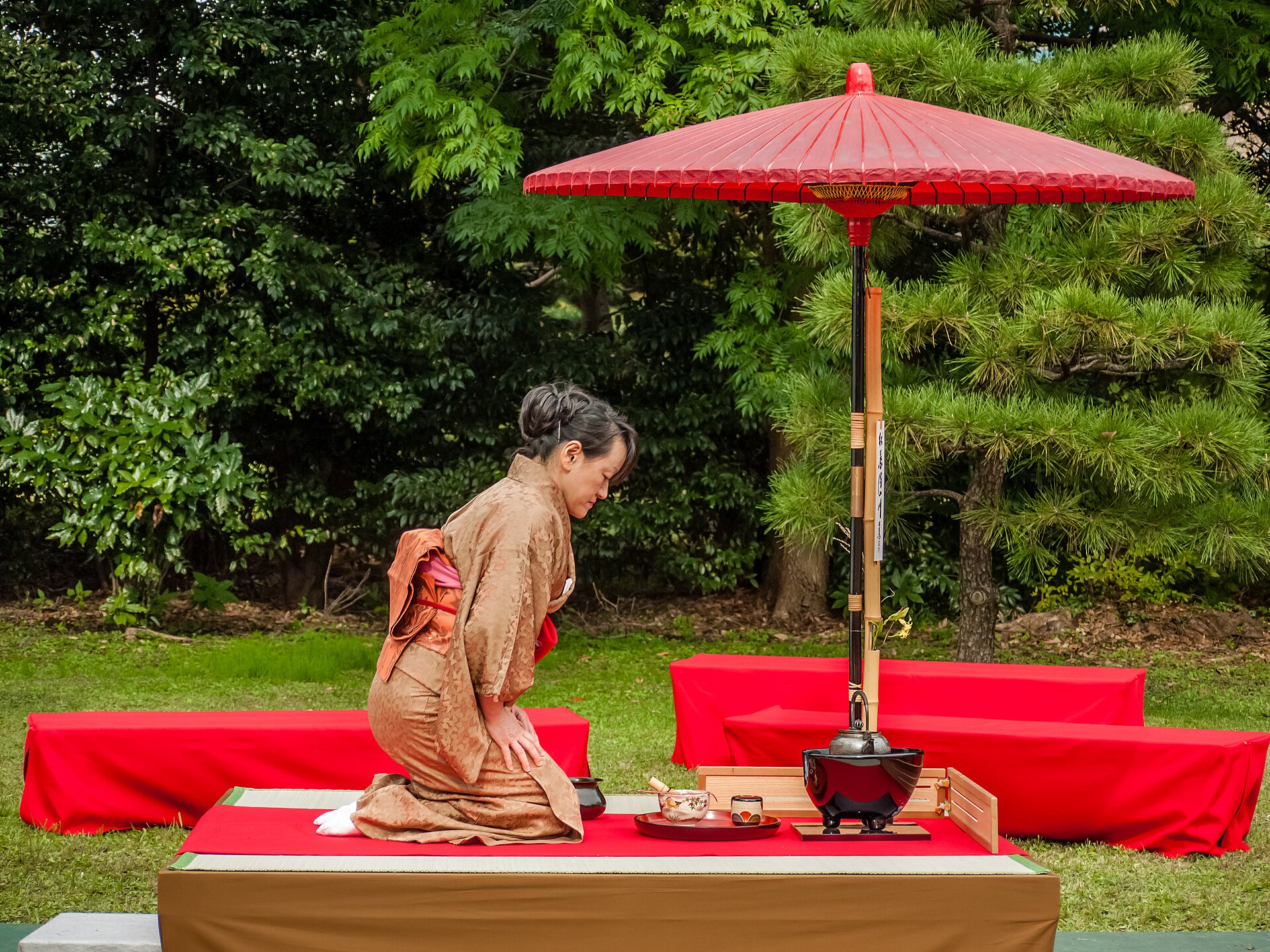
"Tea ceremony" gets used loosely for two very different traditions — Chinese and Japanese — that share an ancestor but diverged centuries ago into distinct practices with different teas, tools, and purposes. Neither is a single rigid ritual; each is a spectrum. Here's what actually separates them, and what attending each is really like.
Two traditions, one leaf, different philosophies
Tea culture reached Japan from China roughly a thousand years ago and developed along its own path. The broad strokes: Chinese tea practice kept evolving with the leaf itself — loose-leaf steeping, regional styles, teaware craft — while Japanese practice crystallized around powdered tea and a codified ritual form. Modern Chinese "ceremony" (gongfu cha) is about getting the most from excellent leaf; the Japanese tea ceremony (chanoyu) is about the meaning of the act itself.
The Chinese side: gongfu cha
Gongfu cha — "making tea with skill" — is less a ceremony than a refined brewing practice. The setup is small: a tiny clay pot or porcelain gaiwan (a lidded bowl), small cups, a tea tray to catch spills. The method: lots of leaf, very short steeps, many rounds — five, ten, sometimes fifteen infusions from the same leaves, each tasting different.
The tea: quality loose leaf — oolongs, puerh, fine greens — never powdered.
The atmosphere: relaxed and social. People talk; the host brews; the tea is the point. There is etiquette — warming the vessels, rinsing the leaf, filling cups partially, serving in rounds — but it serves the brewing, not the reverse.
The emphasis: appreciation of the leaf. The ritual exists to extract and taste the tea at its best.
The Japanese side: chanoyu
The Japanese tea ceremony is a choreographed aesthetic practice — part hospitality, part meditation, part performance of prescribed movement (temae). A host prepares matcha — powdered green tea whisked into a froth — for guests in a dedicated tea room, following procedures studied for years. Every object has meaning: the scroll, the flower, the bowl's orientation.
The tea: matcha, whisked — either thin (usucha) or thick (koicha).
The atmosphere: formal, hushed, deliberate. Silence or quiet exchange; attention to the room, the season, the implements.
The emphasis: presence — the concepts of ichi-go ichi-e ("one time, one meeting") and wabi (unassuming beauty) make each gathering unrepeatable and worth full attention.
Side by side
| Chinese gongfu cha | Japanese chanoyu | |
|---|---|---|
| Tea | Whole leaf, steeped repeatedly | Powdered matcha, whisked |
| Vessels | Small pot or gaiwan, small cups | Tea bowl (chawan), bamboo whisk, scoop |
| Rounds | Many short infusions | One bowl per guest |
| Talk | Relaxed, social | Minimal, prescribed |
| Center | The tea's flavor | The shared moment |
| Skill path | Learned by doing; informal | Schools (Urasenke etc.); years of study |
The role of matcha in the Japanese ceremony
Matcha isn't just the beverage in chanoyu — it's part of why the ceremony exists in its current form. Powdered tea was how tea was prepared in China during the era when the practice traveled to Japan; Japan preserved and ritualized that form while China moved on to steeping whole leaves. The whisking itself is built into the ritual: preparing the bowl, warming the whisk, the precise motion — a whole vocabulary of movement developed around this one tea. It's also why matcha and ceremony are culturally inseparable in Japan: to drink whisked tea there at all is to borrow, however casually, from chanoyu. More on the tea itself in what is matcha.
Diversity inside each tradition
Neither side is monolithic. "Chinese tea" covers Chaozhou's highly ritualized gongfu style, the lidded gaiwan culture of Sichuan teahouses, and ordinary thermos-and-leaves daily drinking. "Japanese tea" covers the tea ceremony but also the everyday sencha most people actually drink, the powdered tea in convenience bottles, and regional customs like Okinawa's sanpin (jasmine) tea. The ceremonies are the famous tip of much larger, much more casual cultures.
What a guest actually experiences
At a gongfu session: sit, receive small cups, drink each round while it's hot, watch the leaves unfurl between steeps. The host may pass the lid or the empty cup for you to smell the aroma — do it; that's part of the tasting. Conversation is normal.
At a tea ceremony: more formality — remove shoes, sit seiza or as directed, bow when sweets are served, take the bowl with both hands, rotate it slightly before drinking (a gesture of respect for the bowl's "front"), finish in a few sips, admire the bowl. You won't be expected to know the steps — hosts guide guests, and sincerity counts more than correctness.
Neither is "the real tea ceremony"
Avoid the ranking instinct. Gongfu cha and chanoyu are different answers to the same question — how to make tea matter. China answers with a craft focused on the leaf; Japan answers with a ritual focused on the moment. Both are also bigger than their famous forms: everyday Chinese tea drinking is far more casual than gongfu, and Japanese people mostly make casual sencha, not ceremony, day to day. If your interest is the tea itself, start brewing gongfu-style at home — the method is in steep times. If your interest is the experience, a demonstration chanoyu at a cultural center is the honest first step — watch, listen, drink slowly.