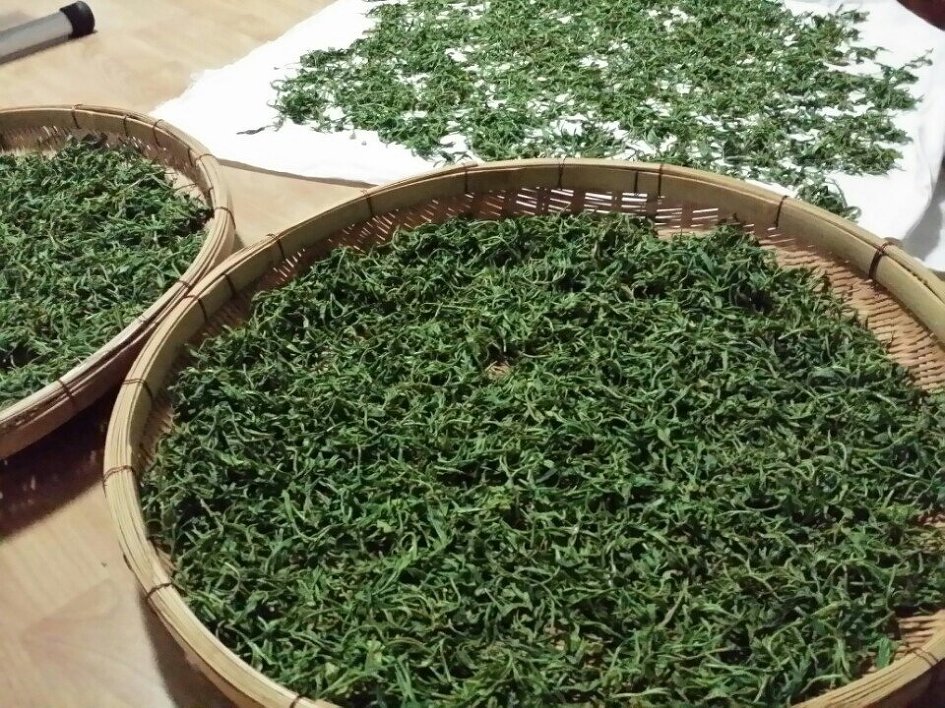
Green tea and black tea come from the same plant, Camellia sinensis. A green-tea leaf and a black-tea leaf can be picked from the same bush on the same day — the difference is what happens to them after picking. Green tea is heated soon after harvest so the leaf stays chemically "green." Black tea is intentionally oxidized until the leaf turns dark and the flavor turns malty. Everything else — color, taste, caffeine, brewing — follows from that one fork in the road.
The fork: oxidation
Inside a tea leaf are enzymes that, when exposed to air, convert the leaf's natural compounds into darker, richer-tasting substances. This process is called oxidation, and it is the single most important idea in tea classification.
To make green tea, producers apply heat quickly — steaming in Japan, pan-firing in much of China — which deactivates those enzymes and stops oxidation before it starts. To make black tea, producers do the opposite: they roll and bruise the leaves to expose them to air, then leave them to oxidize fully before drying. Same leaf, two outcomes.
A useful picture: oxidation in a tea leaf works a lot like a cut apple turning brown. Green tea is the slice dipped in lemon water and kept pale; black tea is the slice left on the counter until it darkens and changes character.
What reaches your cup
| Green tea | Black tea | |
|---|---|---|
| Processing | Heated early to stop oxidation | Fully oxidized before drying |
| Dry leaf color | Green to deep green | Dark brown to black |
| Liquor color | Pale yellow to yellow-green | Amber to deep copper |
| Typical flavor | Fresh, grassy, vegetal, sometimes nutty or seaweed-like | Malty, brisk, fruity or honeyed, sometimes smoky |
| Typical body | Light to medium | Medium to full |
| Starting brew temp | ~70–80°C (158–176°F) | ~90–100°C (194–212°F) |
| Common styles | Sencha, gyokuro, Dragon Well, gunpowder | Assam, Ceylon, Keemun, English Breakfast blends |
The color difference is the easiest field test: a green tea that brews dark amber, or a black tea that brews pale yellow, is either a mislabeled bag or a brew that needs adjusting — more on that in why teas have different colors.
Caffeine: the honest answer
The common belief is that green tea is low in caffeine and black tea is high. The reality is less tidy. Caffeine in a cup depends on leaf grade (buds and young leaves carry more), how much leaf you use, water temperature, and steeping time — not just the category. A strong-brewed green tea can easily out-caffeinate a weak black tea.
As rough guidance, an average cup of either usually lands somewhere between about 20 and 50 mg of caffeine, compared with roughly 90–120 mg in a typical cup of coffee. Black tea tends to sit toward the higher side of that tea range, and shaded Japanese greens like gyokuro can be surprisingly high. If caffeine is a real constraint — pregnancy, medication, sensitivity — treat any single number you read as approximate and follow your clinician's guidance, not a chart on a blog.
Cultivar and processing matter as much as category
"Green" and "black" describe the method, not a single taste. Within each category, the cultivar planted, where it grew, and small processing choices swing the cup widely. A Japanese sencha — steamed quickly — tastes marine and vivid green; a Chinese Dragon Well — pan-fired in a hot wok — tastes toasted and chestnut-sweet. Both are green teas. On the black side, a brisk, malty Assam and a smooth, cocoa-noted Keemun barely resemble each other either. When a package gives you a region or a style name, that detail usually predicts flavor better than the color category alone.
Brewing differences that matter
Because green tea skipped oxidation, more of its sharp, bitter compounds remain locked in the leaf. Boiling water drags them out fast, which is why green tea brewed like a breakfast tea tastes punishing. Cooler water — think steaming rather than boiling — gives a sweet, mild cup. Black tea's oxidized chemistry is more forgiving; it handles near-boiling water and longer steeps, which is exactly what produces its deep, brisk character. Starting parameters for both are in the green tea temperature guide and steeping times by tea type.
Which should you choose?
Choose green tea if you like your drinks fresh, light, and vegetal — the flavor direction of steamed greens, sweet peas, and toasted rice — and you don't mind paying a little attention to water temperature. Choose black tea if you want something closer to the coffee experience: a full, brisk cup that takes milk well and tolerates careless brewing.
If you want something between the two, that middle ground has a name — oolong, the deliberately half-oxidized category. And if you want the gentlest end of the spectrum, white tea versus green tea compares the two mildest styles.
A short buying note
Category alone doesn't determine quality. A fresh, well-stored everyday green tea beats a stale premium black tea every time. Whatever you pick, buy a small quantity first, check how it smells when you open the bag — vivid and aromatic is good, flat and dusty is not — and keep it away from light and air as covered in how to store loose leaf tea.