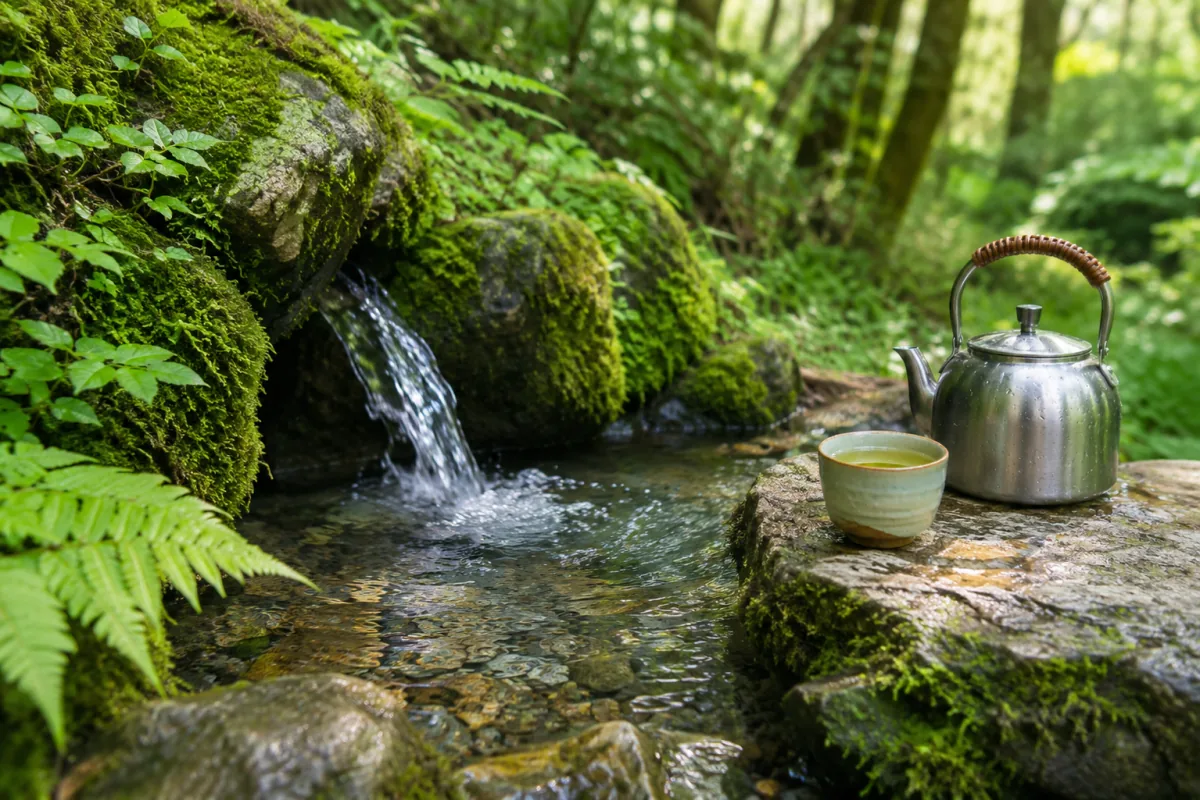
Imagine you're hiking in the mountains and come across a small spring. The water is flowing over rocks, looks completely clear, and seems much fresher than the water you drink at home.
You might even see someone filling bottles or containers from the spring. It's tempting to take some home, especially if you've heard that natural spring water makes tea taste better.
But is it actually safe to drink?
The answer isn't always yes. Water can look clean and still contain bacteria, parasites, or chemicals that you can't see or smell. And boiling it before making tea doesn't solve every water safety problem.
If you're thinking about collecting spring water for drinking or brewing tea, here's what you should know first.
Can You Drink Water Straight from a Natural Spring?
Not necessarily.
A natural spring is a place where groundwater flows naturally to the surface. Unlike tap water, water from a wild spring may not go through regular treatment or testing before people collect it.
Some springs may have good water quality, but others can be affected by what's happening in the surrounding area.
For example, rainwater can wash animal waste, soil, and other pollutants into the ground. Nearby farms, septic systems, and human activity can also affect groundwater.
The tricky part is that contaminated water doesn't always look dirty.
It might be completely clear, have no unpleasant smell, and taste quite fresh. That doesn't mean it's safe to drink.
So if you find a beautiful mountain spring while traveling, don't assume you can fill a bottle and drink it straight away. A clean appearance is not a reliable way to judge water safety.
Is Mountain Spring Water Better for Making Tea?
Many tea drinkers like the idea of using natural mountain spring water.
It sounds simple: the water comes from nature, contains natural minerals, and hasn't been heavily processed. Surely that should make a better cup of tea?
There is some truth behind the interest in spring water. The minerals naturally present in water can affect how tea tastes.
For example, calcium and magnesium may interact with compounds in tea leaves. Depending on their amounts, the water can influence the tea's aroma, color, bitterness, and overall taste.
Research published in Food Chemistry has found that different water sources can produce noticeable differences in tea infusions. One study also found that mountain spring water with certain mineral characteristics worked well for some Chinese teas.
But here's something important: not every mountain spring has the same water composition.
One spring may produce water with relatively low mineral content, while another may contain much higher levels of dissolved minerals. Their effects on tea can be quite different.
Also, good flavor doesn't mean the water is safe to drink.
If you're interested in how water affects tea flavor, you can also read our guide to using bottled spring water for brewing tea.
What Can Make Natural Spring Water Unsafe?
When people collect water from a mountain spring, they often pay attention to whether the water looks clean and whether there are any obvious signs of pollution.
Those things can be useful clues, but they aren't enough to confirm that the water is safe.
Here are some possible sources of contamination.
Animal waste
Wild animals and livestock may visit the area around a spring. Their waste can carry harmful microorganisms into the water, particularly after rainfall.
Rainwater and surface runoff
Heavy rain can wash dirt, animal waste, and other pollutants from the surrounding land into a spring or its groundwater supply.
Nearby farms and buildings
Fertilizers, pesticides, septic systems, and other human activities can affect groundwater. Some chemical contaminants cannot be detected by looking at or tasting the water.
Natural minerals and metals
Not all water contamination comes from human activity. Depending on the local geology, groundwater may naturally contain substances such as arsenic or other metals at levels that make it unsuitable for drinking.
This is why a spring that looks untouched and sits deep in a forest isn't automatically safe.
The CDC explains that private water sources, including springs, may contain germs and chemicals and may not be tested regularly. You can read more in its guide to private drinking water and public health.
Does Boiling Mountain Spring Water Make It Safe?
This is probably the first solution many people think of.
After all, tea requires hot water anyway. If you collect spring water, bring it home, and boil it in a kettle, shouldn't that make it safe?
Boiling does help, but it has an important limitation.
Bringing clear water to a rolling boil for one minute can kill many disease-causing bacteria, viruses, and parasites. At elevations above 6,500 feet, the CDC recommends boiling for three minutes.
However, boiling does not remove chemical contaminants.
For example, if the spring water contains arsenic, lead, nitrates, or other harmful chemicals, heating it won't make those substances disappear. In some cases, evaporation can even concentrate substances left behind.
So don't assume that boiling makes every unknown water source safe.
If you collect water regularly, proper testing is important. If a source is known or suspected to have chemical contamination, don't use it for drinking or tea until it has been appropriately assessed and treated.
You can find more information in the CDC's boil water guidance.
What Should You Check Before Using Spring Water for Tea?
If you have access to a natural spring and are considering using its water at home, don't start with the taste test. Start with safety.
Here are a few things worth checking.
Find out whether the spring is tested.
Some public springs have water quality information available from local authorities. If there are no recent test results, don't assume the source is safe just because people have used it for years.
Pay attention to the surrounding area.
Look for nearby farms, grazing animals, septic systems, roads, buildings, and other possible pollution sources. These observations cannot prove that water is safe, but they may help identify potential risks.
Get the water tested if you plan to use it regularly.
A qualified water testing laboratory can advise which tests are suitable for the source. Depending on the location, these may include E. coli and other indicators of microbial contamination, nitrates, metals, and other locally relevant chemicals.
One test is not necessarily enough to cover every possible contaminant. The testing plan should reflect the spring's surroundings and local conditions.
Don't rely on boiling alone.
Boiling can deal with many biological risks, but it isn't a substitute for checking chemical water quality.
If you cannot confirm that the water is safe, use a reliable drinking water source instead.
Is Natural Spring Water Different from Bottled Spring Water?
Yes, and this is an important difference.
When you buy bottled spring water from a reputable supplier, it is sold as a drinking water product and is subject to applicable food and drinking water requirements in the country where it is sold.
The water may still contain different levels of natural minerals, so two brands can taste quite different. But bottled water is not the same as water you collect yourself from an untested spring.
With wild spring water, you may have no reliable information about its source, mineral composition, or possible contamination.
If your main goal is to improve the flavor of your tea, bottled spring water is a more practical option to explore. You can compare its taste with purified water and see which one you prefer.
For more help choosing water for everyday tea brewing, see our article on whether spring water is good for brewing tea.
Common Questions About Natural Spring Water
Can you drink mountain spring water without boiling it?
Only if the water source has been properly assessed and confirmed safe for drinking. Clear water from an untested mountain spring should not be assumed safe.
Can you boil natural spring water and use it for tea?
Boiling can kill many harmful microorganisms, but it cannot remove chemical contaminants such as arsenic or nitrates. If the source hasn't been tested, boiling alone doesn't guarantee safe drinking water.
Can natural spring water contain bacteria?
Yes. Animal waste, surface runoff, and other environmental sources can introduce harmful microorganisms into natural spring water. Some contamination is impossible to see or smell.
Is water from a deep mountain spring safer than water from a small roadside spring?
Not automatically. A protected groundwater source may have less exposure to some types of surface contamination, but its safety still depends on local geology, land use, and the condition of the spring. Testing is the best way to assess it.
Can I use untreated spring water to cold-brew tea?
It's not a good idea. Cold brewing doesn't involve boiling, so it doesn't provide the same heat treatment that boiling water can offer against many microorganisms. Use drinking water from a reliable, safe source instead.
Does natural spring water always taste better than tap water?
No. Some spring water tastes mild and pleasant, while other sources have a noticeable mineral taste. Tap water can also be perfectly suitable for tea if its quality and taste are good.
Natural spring water can be an interesting option for tea lovers, especially when its mineral composition gives the tea a flavor they enjoy. But don't let the word "natural" make you overlook water safety. Before thinking about how a spring might improve your tea, make sure the water is actually safe to use.