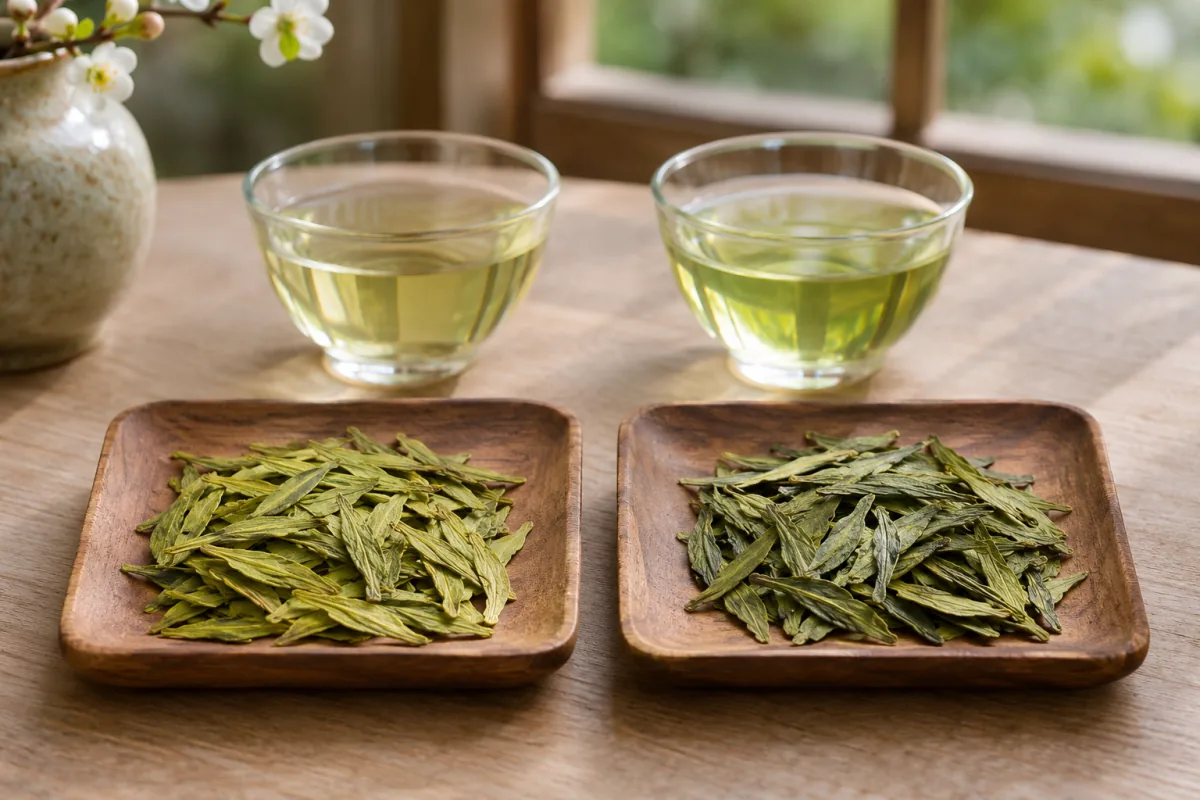
You are looking at two bags of Chinese green tea. Both say Longjing, but one is labeled "West Lake Longjing" and costs quite a bit more.
Is the more expensive one actually different? And does the name on the package tell you where the tea was grown?
This can be confusing if you are buying Chinese tea for the first time. The important thing to know is that West Lake Longjing is a specific type of Longjing tea associated with a protected growing area. Regular Longjing can come from other recognized production areas in Zhejiang Province.
The difference is mainly about origin, not simply how the dry leaves look.
What Is the Difference Between West Lake Longjing and Regular Longjing?
Longjing is a well-known Chinese green tea from Zhejiang Province. It is also called Dragon Well tea.
Under China's geographical indication standard for Longjing tea, the recognized production areas include Xihu (West Lake), Qiantang, and Yuezhou.
West Lake Longjing comes from the designated West Lake production area in Hangzhou. Longjing from Qiantang or Yuezhou is still Longjing, but it is not West Lake Longjing.
Here is a simple comparison:
| Name on the package | What it generally means |
|---|---|
| Longjing | The broader tea name; check the actual growing area |
| West Lake Longjing | Longjing from the designated West Lake area |
| Xihu Longjing | Another name for West Lake Longjing; Xihu is the Chinese pinyin for West Lake |
| Qiantang Longjing | Longjing from the Qiantang production area |
| Yuezhou Longjing | Longjing from the Yuezhou production area |
So, if a shop sells a tea labeled simply "Longjing Green Tea," it may be from outside the West Lake area. That does not automatically make it bad tea. It simply means you should not assume it is West Lake Longjing.
Why Is West Lake Longjing More Expensive?
West Lake Longjing often costs more because of its specific growing area, reputation, and demand.
The West Lake area has a long history of producing famous Longjing tea. Its name carries a strong reputation among Chinese tea drinkers, and genuine tea from this area can be in high demand.
There are also differences in harvest timing, tea varieties, leaf selection, and production methods. Early spring harvests, for example, are often more expensive because the picking season is short and the young leaves are limited.
But price alone does not prove that a tea is genuine West Lake Longjing.
A seller can use attractive packaging, words such as "premium," or a high price to make a product look special. You still need to check the origin information.
It is also worth remembering that Longjing from Qiantang or Yuezhou can be enjoyable to drink. If you mainly want a pleasant everyday green tea, you may not need to pay extra for the West Lake name.
How to Check If a Package Is Really West Lake Longjing
Imagine you are shopping online and find a product called "Premium West Lake Dragon Well Green Tea." The photos look attractive, but the product description only says that it is a famous Chinese tea.
That is not enough information to understand where the tea comes from.
Here are a few things worth checking.
Look for a specific growing area.
A more informative product description should identify West Lake or Xihu in Hangzhou, rather than only saying "China" or "Zhejiang."
If the seller provides information about a more specific village or production area, that can help you understand the origin claim.
Check the origin information on the package.
West Lake Longjing has specific origin protection requirements in China. Official protection measures use a dedicated label system that can include information about the origin of the fresh leaves, tea varieties, picking, and processing.
If you are buying a product that claims to be genuine West Lake Longjing, look for relevant origin or traceability information.
However, not every overseas retailer will display the same Chinese certification details on its website. The absence of a particular label on an international product page does not, by itself, prove that the tea is fake. Ask the seller for more information if the origin matters to you.
Read the seller's description carefully.
Compare these two descriptions:
- "Premium Chinese green tea, fresh and delicious."
- "West Lake Longjing from Hangzhou, with information about its growing area and harvest."
The second gives you more useful information. A detailed description is not proof of authenticity, but it gives you something specific to check.
Ask the seller directly.
If you are buying from a specialty tea shop, ask:
- Is this tea from the West Lake production area?
- Can you tell me which area or village it comes from?
- Is there any origin or traceability information?
- When was the tea harvested or packed?
A seller who knows the product should be able to explain the difference between West Lake Longjing and Longjing from other areas.
Can You Tell West Lake Longjing by Its Appearance?
Not reliably.
Both West Lake Longjing and Longjing from other production areas can have the familiar flat, smooth leaves. That shape comes from the pan-firing and shaping process used to make the tea.
You may notice differences in leaf size, color, or overall appearance between products. But these differences can also be affected by the tea variety, harvest time, processing, and grade.
In other words, a flat, bright green leaf does not prove that the tea comes from West Lake.
Be careful with product descriptions that make claims such as:
- The flatter the leaf, the better the tea.
- Only bright green leaves are authentic.
- A particular leaf shape proves West Lake origin.
These are too simple to be reliable tests.
If you want to understand what Longjing normally looks and tastes like, start with our guide to what Longjing tea is and how Dragon Well green tea tastes.
Does West Lake Longjing Taste Better?
It can be excellent, but the answer depends on the individual tea and your own taste.
A well-made West Lake Longjing may have a gentle roasted aroma, a nutty or chestnut-like flavor, and a smooth finish. Some people enjoy its balance and subtle sweetness.
However, not every West Lake Longjing will taste better than every Longjing from another area.
A fresh, well-processed tea from Qiantang or Yuezhou may be more enjoyable than an older or poorly stored West Lake product.
The harvest, leaf quality, processing, storage, and brewing method all affect the final cup.
This is why it is useful to separate two questions:
- Where does the tea come from? This is about its origin and whether the West Lake name is supported.
- How good is the tea itself? This is about its condition, aroma, flavor, and how well it was made and stored.
A famous origin can be a useful starting point, but it should not replace checking the actual tea.
Which Longjing Should You Buy?
The best choice depends on what you want from the tea and how much you want to spend.
Choose West Lake Longjing if:
- You specifically want to try tea from the famous West Lake area.
- The seller provides useful origin information.
- You are comfortable paying more for a tea with a specific growing-area claim.
- You want to explore a well-known regional style of Chinese green tea.
Choose regular Longjing if:
- You mainly want to enjoy the flat-leaf Dragon Well style.
- You are buying everyday green tea rather than collecting famous regional teas.
- You find a seller who provides clear information about the growing area.
- You would rather spend less while exploring different Chinese green teas.
If you are new to Longjing, you do not need to start with the most expensive package. Buy a small amount first, brew it carefully, and see whether you enjoy its flavor.
You can also use our guide on how to tell if loose leaf tea is good quality before you buy to check packaging, aroma, and seller information when comparing different products.
Is Xihu Longjing the Same as West Lake Longjing?
Yes. Xihu is the pinyin spelling of 西湖, the Chinese name for West Lake.
That means Xihu Longjing and West Lake Longjing refer to the same specific regional tea name.
You may see either spelling on a product page or package, especially when buying Chinese tea from international sellers.
The important point is not which English spelling the seller uses. It is whether the tea actually comes from the designated West Lake production area.
If the product only says Longjing, it may come from another recognized Longjing production area. If it says Xihu Longjing or West Lake Longjing, the seller is making a more specific origin claim.
Is West Lake Longjing Worth the Extra Money?
It can be, especially if you are interested in trying tea from this particular growing area. Its reputation and specific origin are part of what makes it desirable.
But you do not have to buy West Lake Longjing to enjoy Dragon Well tea.
For everyday drinking, a well-made Longjing from another production area may be a more affordable choice. The most important things are clear product information, good storage, a clean aroma, and a flavor you enjoy.
If you are unsure, compare a small amount of each rather than choosing only by the name or price. That is often the easiest way to discover which Longjing you actually prefer.